

A Conceptual Framework for Understanding Language, Information, and Trauma
(Working Model by Joy Plote, LPC, CI/CT)
Important Note:
The following is proposed as a conceptual framework to stimulate discussion and future research. It is not presented as an established component of the Adaptive Information Processing (AIP) model or any established protocol. It is intended as an educational lens for understanding how language and information access may influence adaptive development.
Introduction
One of the central assumptions of the Adaptive Information Processing (AIP) model is that the human brain has an innate capacity to move toward health by integrating new experiences with existing adaptive memory networks.
When adaptive information is available, new experiences can be organized, understood, and incorporated into a coherent understanding of oneself and the world.
Trauma interrupts this natural process.
EMDR facilitates the reconnection of traumatic memories with adaptive information.
But what happens when adaptive information never existed?
This question forms the foundation of what I propose as The Adaptive Information Gap.
Defining the Adaptive Information Gap
The Adaptive Information Gap refers to the absence of developmentally necessary information that would normally allow an individual to interpret, organize, and integrate life experiences in healthy ways.
Unlike traumatic memories themselves, the Adaptive Information Gap describes information that was never acquired, never explained, or never made accessible during development.
This missing information may result from:
- language deprivation
- information deprivation
- communication barriers
- neglect
- social isolation
- inaccessible education
- cultural exclusion
- developmental trauma
The result is not simply missing knowledge.
The result is missing adaptive meaning.
Adaptive Information Is Learned
Adaptive information is rarely innate.
Children learn it through thousands of interactions.
For example:
“I am safe.”
“My feelings make sense.”
“Adults protect children.”
“Mistakes are opportunities to learn.”
“My body belongs to me.”
“I can ask questions.”
“People can help me.”
“Bad things are not always my fault.”
“I’m a good person.”
These beliefs are not created in isolation.
They emerge through:
- language
- relationships
- observation
- education
- explanation
- incidental learning
- emotional attunement
The Role of Incidental Learning
One of the most overlooked sources of adaptive information is incidental learning.
Hearing children constantly absorb information that is never intentionally taught.
They overhear:
Parents solving problems.
Adults apologizing.
Arguments being repaired.
Conversations about emotions.
Family values.
Discussions about safety.
Explanations after frightening events.
Rules.
Expectations.
Social norms.
Pop culture.
Consequences.
Thousands of these small experiences gradually build adaptive memory networks.
Many Deaf children with limited language access do not receive equivalent opportunities.
The result is not simply fewer words.
It may be fewer adaptive frameworks through which to understand experience.
The Brain Still Makes Meaning
The brain does not wait for complete information before creating meaning.
Instead, it attempts to organize experience using whatever information is available.
Imagine a child experiencing abuse.
The brain asks:
“What happened?”
“Why?”
“Who is responsible?”
“What does this mean?”
If adaptive information is available, the child may eventually learn:
“Adults are responsible.”
“This was abuse.”
“It wasn’t my fault.”
“If adaptive information is absent, the brain may still answer those questions:
“It’s my fault”
“This is normal.”
“This only happens to me.”
“I deserved it.”
“It happened because I’m Deaf.”
These conclusions are not evidence of irrational thinking.
They are often evidence of an Adaptive Information Gap.
A Parallel With Cloze Theory
Interpreters may recognize a familiar cognitive process.
During interpretation, we constantly use cloze skills.
When information is incomplete, we draw upon existing linguistic, cultural, and experiential knowledge to predict what comes next.
For example:
Yesterday I went to the ________.
Most people would effortlessly predict:
store
doctor
park
work
These predictions occur because we possess extensive background knowledge.
The prediction is not random.
It is informed by existing cognitive networks.
The AIP model suggests that the brain functions similarly.
When experiences occur, the brain asks:
“What does this mean?”
It answers using the information already available.
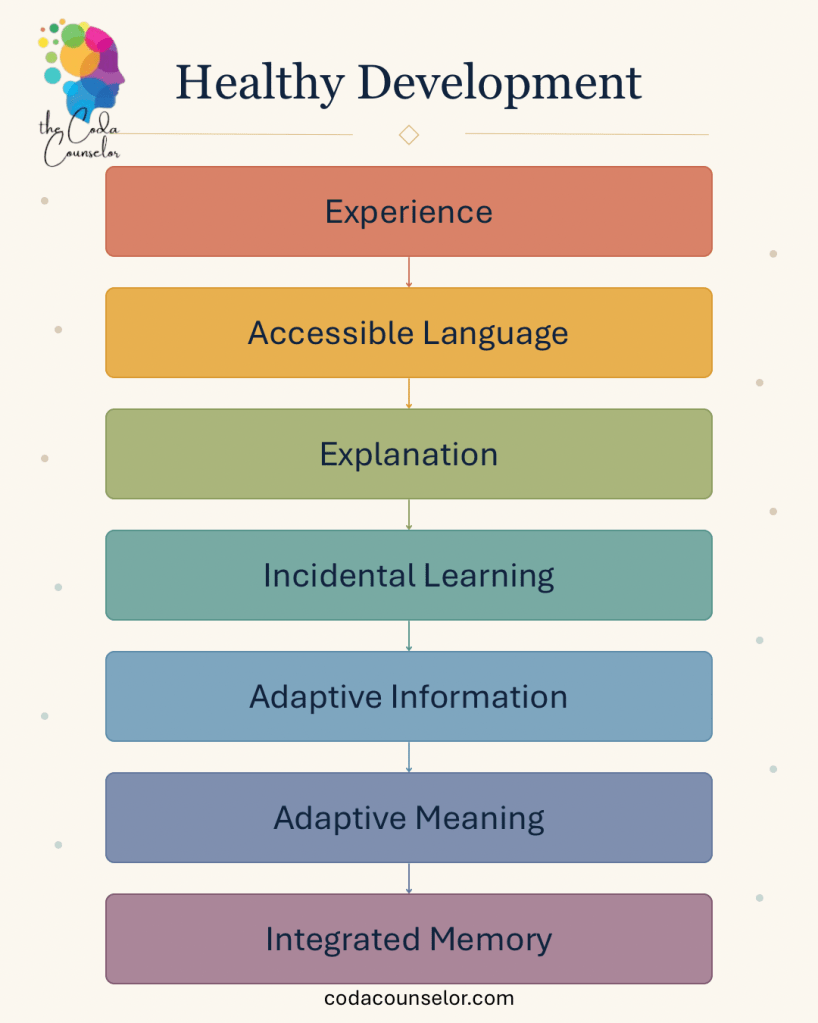
When adaptive information is abundant, healthy meaning is more likely.
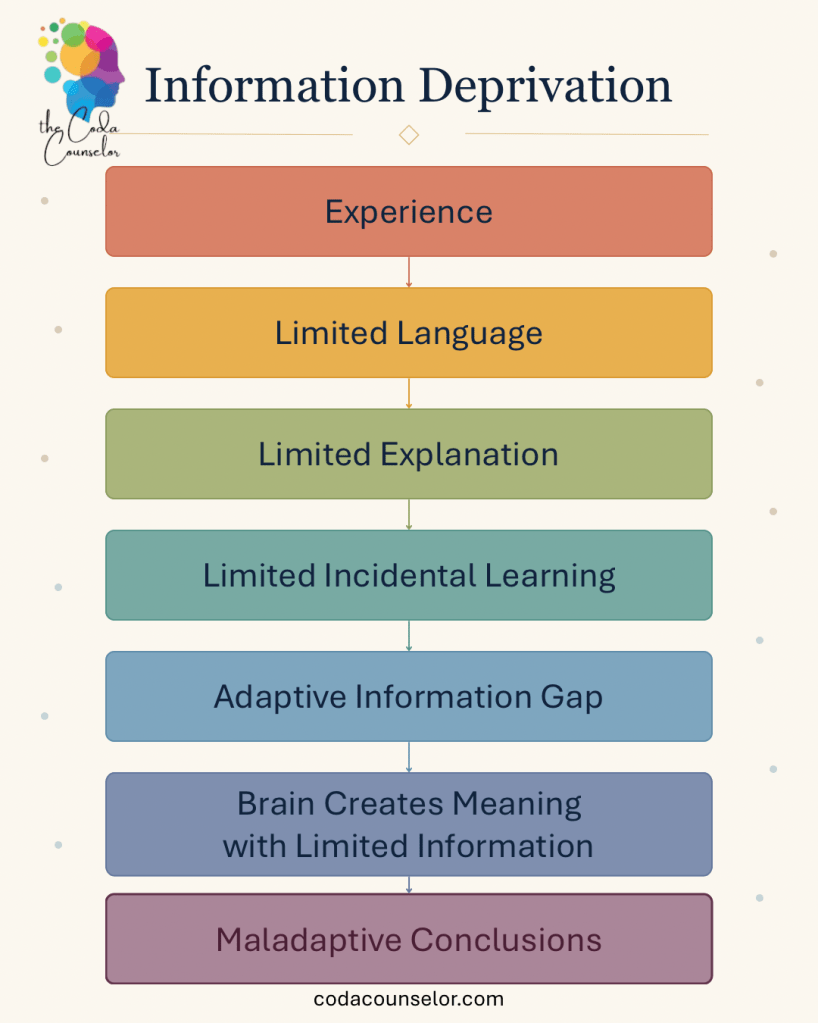
When adaptive information is absent, the brain still fills in the blanks—but the conclusions may become maladaptive. This is not because the brain is defective. This is a survival skill. The skill is developed and honed because the available information was and remains incomplete.
The Adaptive Information Gap Model
Implications for EMDR
This framework suggests an important clinical question:
When processing becomes blocked, is the problem always the traumatic memory?
Or could the obstacle be that adaptive information was never available?
This perspective does not replace the AIP model.
Rather, it expands our understanding of the conditions under which adaptive processing occurs.
It may help explain why some clients require additional preparation, psychoeducation, or cognitive interweaves before traumatic memories can fully integrate.
Implications for Interpreters
Interpreters are uniquely positioned to recognize communication patterns that may reflect adaptive information gaps.
This does not make interpreters responsible for identifying treatment interventions.
However, it may help interpreters understand why:
- clients struggle to answer seemingly simple questions
- conceptual language appears limited
- processing becomes blocked
- educational explanations emerge during therapy
- cognitive interweaves may become clinically relevant
Understanding the Adaptive Information Gap allows interpreters to appreciate the therapeutic process without stepping outside their professional role.
Future Directions
The Adaptive Information Gap is proposed as a framework for future exploration.
Questions worthy of investigation include:
- How does language deprivation influence adaptive memory development?
- What role does incidental learning play in trauma recovery?
- Can adaptive information gaps be identified across different populations?
- How do interpreters contribute to communication about adaptive information while maintaining ethical boundaries?
- How might this framework inform trauma-informed practice across disciplines?
- How does this help us identify the depth of harm that is caused by language deprivation?
Closing Reflection
Perhaps one of the most important questions we can ask is not:
“What happened to this person?”
Nor even:
“How did they respond?”
But rather:
“What information should have been available to help them understand what happened—but never was?”
That question may deepen our understanding of language injustice, trauma, communication, and healing.


Leave a Reply